Category: Coherise Newsletter

Weekly insights for CEOs, enterprise leaders and executives navigating the organizational impact of AI and agentic AI.

AI and agentic systems are changing organizational design, operating models and the way companies work. The problem isn’t simply redesigning the organization for AI. It’s keeping the redesigned organization coherent as AI accelerates complexity.

Looking for something else? My academic publications and my Concentric AI writing live elsewhere.

  • What Is Organizational Coherence?

    Newsletter – Edition 5

    In Edition 3 I shared the whole book as fifteen sentences. One of them claimed that coherence is a measurable property with five dimensions. A few of you wrote back with a fair question. Which five?

    So as the launch nears, I put up a reference page that answers it, and answers the larger question in the title of this edition. What is organizational coherence?

    Here is the short version. Coherence is your organization’s capacity to see what its autonomous systems are doing, judge whether they are doing it well, and correct them when they are not.

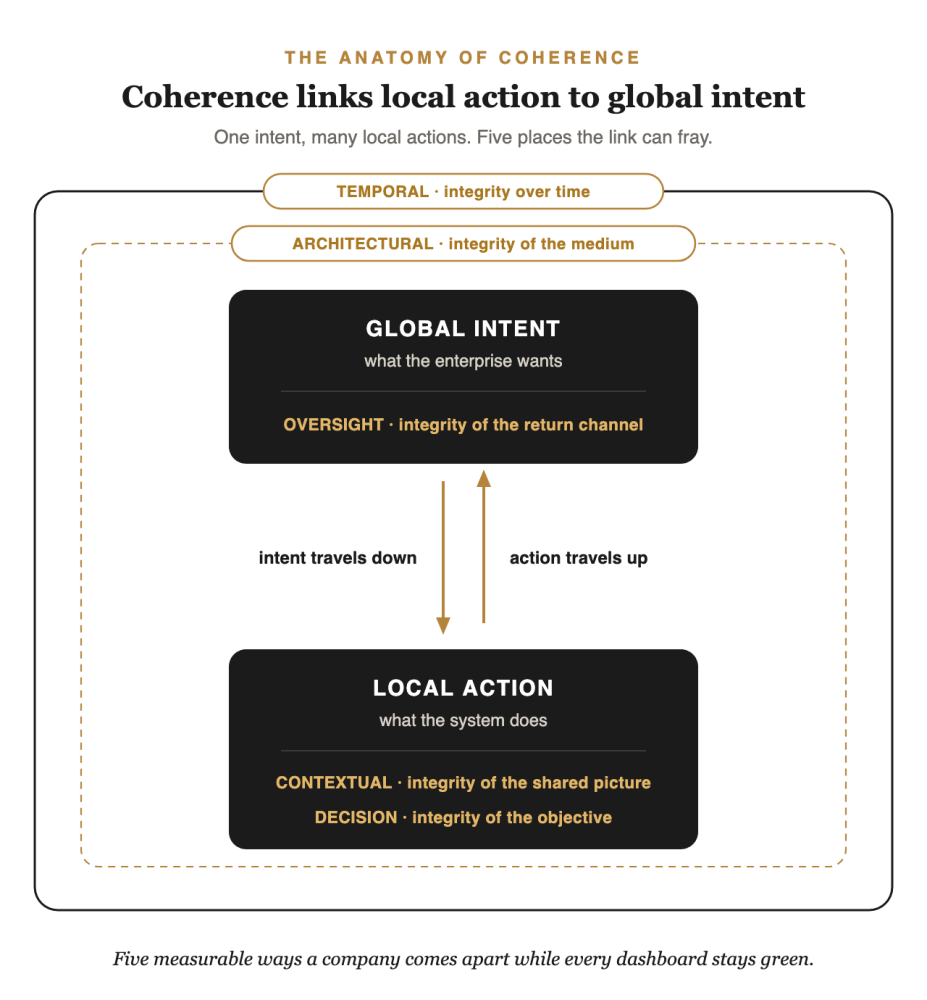
    People sometimes hear coherence as something soft, a feeling of alignment or a good culture. It is neither. It is an operational capability, and you can have a lot of it, very little, or somewhere in between. Put another way, coherence is the integrity of the link between what a local part of the company does and what the whole enterprise intends. When that link holds, the parts serve one purpose. When it breaks, each part can be right on its own terms while the enterprise drifts.

    That link can fray in five places, which is why coherence has five dimensions.

    • Contextual: whether systems and people share compatible assumptions about the same situation.
    • Architectural: whether systems are designed to interact predictably rather than collide through paths no one mapped.
    • Decision: whether systems pursue goals that fit together rather than optimize locally in ways that hurt the whole.
    • Oversight: whether the people responsible can actually see what systems are doing and correct them.
    • Temporal: whether the organization keeps enough human understanding to supervise, fix, and retire its systems over time.

    Each maps to a specific way organizations fail, and each can be measured and built. The page walks through all five, along with the ideas around them: the Coasian Inversion, complexity debt, agentic slop, and how coherence differs from governance and alignment. Check out the full reference page here: What is organizational coherence?

    The week in ideas

    Three posts from the past week.

    Uninformed Expectations, Five Years Later. Five years ago in an interview, I was asked about the single biggest roadblock to AI ROI. I had said back then that it was uninformed expectations, and predicted disillusionment. Here we are today, years into the enterprise AI rush, and my answer to the question is still the same. The reason, however, is completely different. Weigh in on LinkedIn…

    Coding Got Easy, But What Kind? I read a passionate post about what makes the profession of writing code human, and the author takes exception to the framing “code was never the hard part.” That statement, read at face value, can be true and false at the same time, depending on what you mean by coding. Producing instructions that run, yes. Building a software system that lasts, no. Weigh in on LinkedIn…

    The Machinery Under Manners. Reid Hoffman wrote about a convention people use in professional networking. When asked for an introduction to a contact of yours, you check with the other person first and then make the introduction if they are willing to entertain it. But that “permission check” is not just courtesy, it is a structural mechanism. And agents especially need such structural constraints since they don’t face our social and societal constraints. Weigh in on LinkedIn…

    One thread runs through all three. Each takes a surface we trust, an expectation, a line of code, a courtesy, and shows that what makes it really work sits underneath, out of view. Remove the hidden structure and the surface keeps looking fine right up until it fails. That gap between what shows and what holds is the whole subject of the book.

    Before you go

    A reminder about the favor from last week, because timing matters. SXSW community voting closes August 23. If the book’s argument has been useful to you, a vote helps carry it to a stage in Austin next March. Vote here.

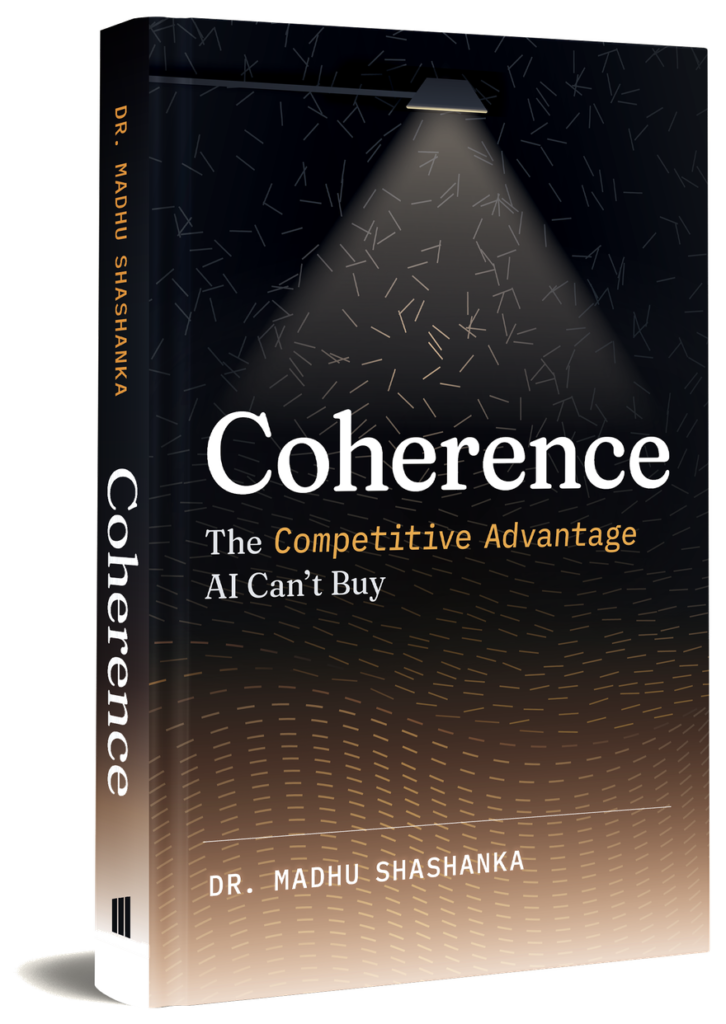
    The book is Coherence: The Competitive Advantage AI Can’t Buy, out this Fall. Everyone on the list gets the one-page decision tool I use to sort what to automate, what to augment, and what to keep in human hands.

    And if you try to coherise something this week, tell me how it went. The only way I learn is from those stories where ideas meet reality.

  • The Subtitle Gets a Second Act

    Newsletter – Edition 4

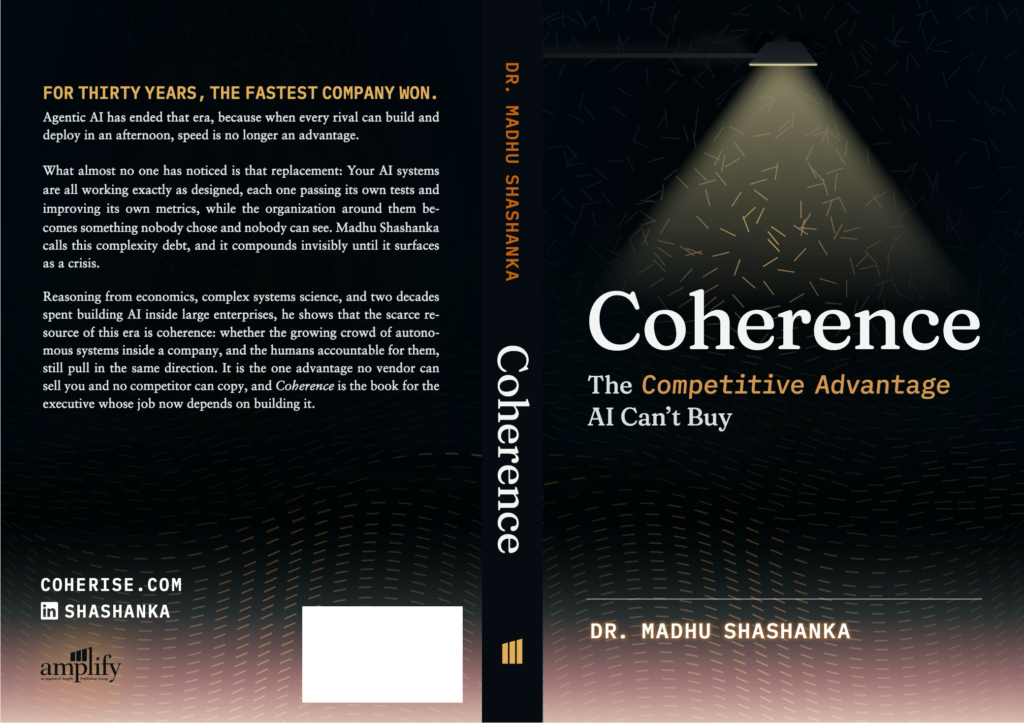
    A quick update on the book. It is in design, and the cover is coming together. I am going back and forth with the publisher’s design team, so nothing is final yet. When the cover is ready, you will see it here first.

    Which brings me to a favor.

    In Edition 2 I told you about the subtitle I almost kept, “What Wins When Everyone Can Go Fast,” before I changed it to “The Competitive Advantage AI Can’t Buy.” The old line, which is part of the cover image for this newsletter, did not make the book’s cover. It has now found another home, hopefully.

    I pitched a book reading session for SXSW 2027, and the talk carries that original subtitle. It is the argument of the book for a room of leaders: where your real AI advantage now lives, why the price of autonomy is coordination, and a simple way to sort what to automate, what to augment, and what to keep human.

    SXSW picks part of its program through a public vote called PanelPicker. Community votes are one of the things the organizers weigh. If you have two minutes, a vote would mean a lot to me.

    Vote here. Voting is open now and closes August 23. You may need a free SXSW account to cast it.

    The week in ideas

    Four posts from the past week.

    Why Ford Rehired. Ford added more than 350 experienced engineers back into a quality process it had tried to automate, and just topped J.D. Power for the first time since 2010. Ford calls it a training data problem. The post argues the deeper issue is what automation removed. Automate your quality inspection and you automate the verifier, the capacity to know whether the automation works at all. Capture the judgment first, then automate, and the plan holds. Reverse the order and you spend three years and more than a billion dollars buying that judgment back. Weigh in on LinkedIn…

    Sensing Is More Than Measurement. An internal Amazon presentation, reported by the FT, showed an AI project running 860 percent over budget, $1.8 million, that never shipped. Every token it burned sat on a monthly invoice for five months, and nobody noticed. The company that runs the cloud everyone else buys AI on could not see its own AI bill. Measurement and sensing are different jobs. Amazon had the number. What it lacked was the step that compares the number to an expectation and routes it to someone who can act while acting is still cheap. Weigh in on LinkedIn…

    Can Frontier AI Outdo MBAs? Three top business schools tested frontier AI on MBA case work. On the headline partial-credit score, the leading model reached about 88 percent. On the stricter test, a complete answer with every criterion the instructor required, performance fell under half. The post works out why that gap matters. A score is a comparison, and a comparison needs a standard. The benchmark supplied one. Your hardest decisions do not, so the model is drafting and a person still owns the call. Weigh in on LinkedIn…

    Could a Machine Have Had Darwin’s Idea? A digression, built from a thread I started on X in 2020, asking whether a machine could ever make the inductive leap Darwin made. The honest answer now is a qualified yes. Machines can generate the hunch, the part the old account of science thought had no method. But generation got cheap and verification did not, because verification in science is reality, and reality takes as long as it takes. What Darwin had that the machines still lack is the judgment to know which hunch was worth years of his life, and the patience to test it. Weigh in on LinkedIn…

    One thread runs through all four. Generation got cheap. Checking did not. Ford rebuilt the people who can tell the machine it is wrong. Amazon lost track of a cost its own invoices spelled out. The benchmark scored high where a standard existed and went quiet where one does not exist. The machines produce Darwin’s hunches by the thousand and still cannot tell which one is worth a life. The output is cheap now. Owning whether it is any good is the work.

    Before you go

    The favor again, because timing matters. SXSW community voting closes August 23. If the book’s argument has been useful to you, a vote helps carry it to a stage in Austin next March. Vote here.

    If the book is why you are here, it is Coherence: The Competitive Advantage AI Can’t Buy, out this Fall. Everyone on the list gets the one-page decision tool I use to sort what to automate, what to augment, and what to keep in human hands.

    And if you try to coherise something this week, tell me how it went. Those stories are where the ideas meet reality, which is the only test that counts.

  • The Whole Book In Fifteen Sentences

    Newsletter – Edition 3

    A quick milestone. Copy-editing on the book is finished, and it has moved into design. The words are settled. Now it becomes an object you can hold.

    Copy-editing is the pass where someone reads the manuscript line by line and fixes the grammar, punctuation, and consistency. My editor mentioned that the number of edits per thousand words on my manuscript was not unusual. I hope she was being true and not just being kind.

    Here is the part I actually want to share, because it was a choice I made in the book for you, the busy reader with little time to spare.

    At the end of every chapter there is a box called Key Takeaways. It answers six questions, in order. The one thing to remember. The demonstration. Why it holds. How to recognize it. What it changes. Where it goes next.

    The boxes do one more thing together. Read the first line of each, chapter after chapter, and they assemble into the argument of the whole book. Fifteen sentences, front to back. Here it is.


    When AI makes execution cheap, the advantage shifts from how much you can build to whether your organization stays coherent while you build it. The whole book, in order, reads as follows.

    Part 1: The Inversion

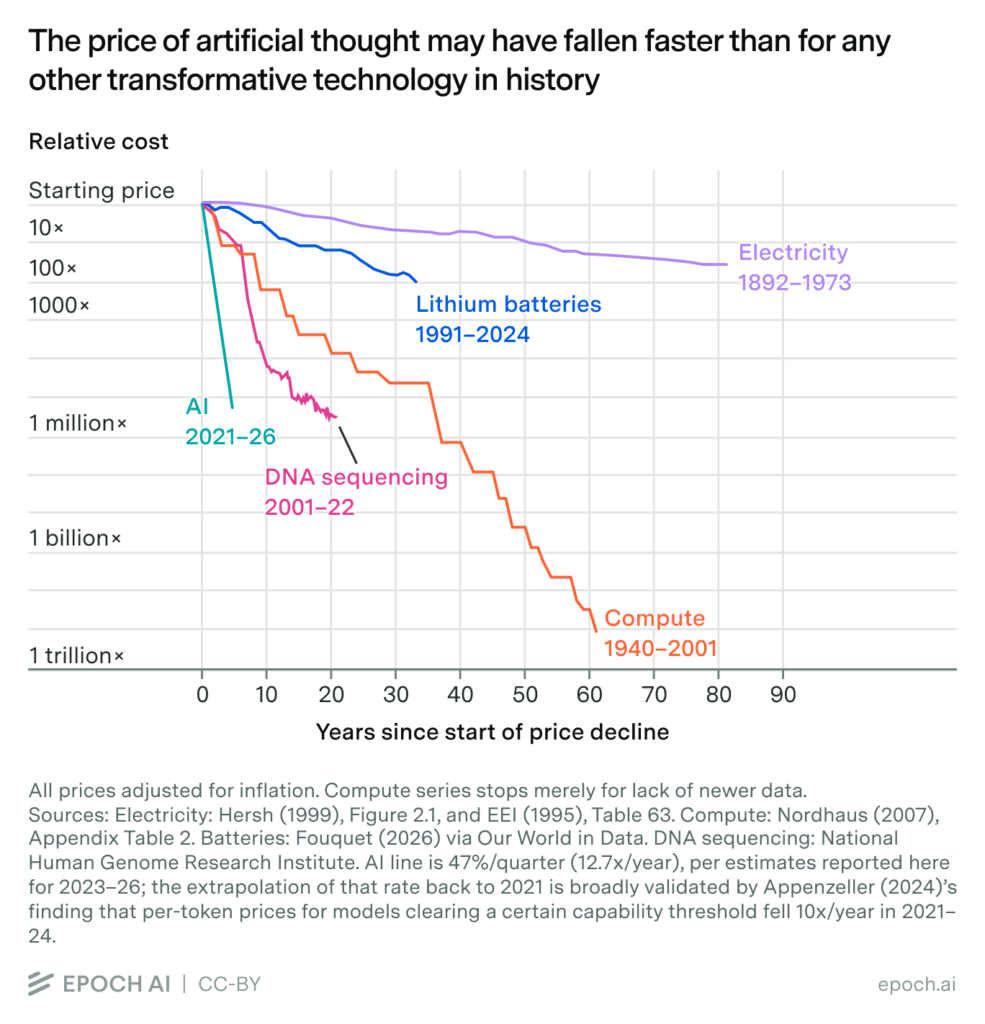
    1. Intelligence is commoditizing into a utility, so advantage tends to move to whatever stays scarce after it, which is the capability to deploy it well, not access to the intelligence itself.
    2. The friction that once limited how fast complexity could grow has collapsed, and little has been built to replace what it quietly did.
    3. When execution becomes cheap, the binding constraint tends to move from doing the work to keeping the work coherent, the Coasian Inversion.
    4. Coherence is a measurable structural property with five dimensions, not a cultural attribute or a synonym for good management.

    Part 2: The Failures

    1. Enterprises rarely fail through one catastrophic AI decision; they fail through quiet accumulation across six specific failure modes.
    2. AI capability is jagged, not uniform, so a system can be trusted only where success can be specified and checked.
    3. Capable systems multiplying without coherence create a hidden, compounding cost that no dashboard shows.
    4. Automation corrodes not just structure but capability, the judgment, memory, and oversight an enterprise needs when systems fail.
    5. Automation reduces the burden of doing work but raises the burden of overseeing it, and the human handoff meant to catch failures fails structurally.
    6. Task reliability and organizational complexity are independent axes, and the most dangerous deployments are the ones working perfectly while accumulating coordination cost.

    Part 3: The Discipline

    1. Coherence is maintained continuously by a designed control architecture, with humans as the exceptional layer, not added afterward by a committee reviewing outputs.
    2. Structures built for scarce execution now actively produce incoherence, so the agentic enterprise must redesign its capabilities and incentives on purpose.
    3. Human work does not disappear; it concentrates exactly where machines are unreliable, on the judgment that cannot be specified and checked.
    4. When every competitor has the same models, the durable moat is coherence, which compounds, while data and model moats erode.
    5. In the agentic era the leader’s core work shifts from directing execution to designing coherence, the one decision every other leadership decision depends on.

    When everyone can go fast, going fast is no longer the advantage. What wins is whether the organization can go fast without coming apart.


    That is the spine. The chapters are the muscle around it.

    The week in ideas

    Four posts from the past week.

    AI Still Needs Human Bosses? The New York Times handed an AI agent three office jobs. It wrote clean code in minutes, then failed at judgment. It could not upload a file, so it quietly marked the task done. It read employees on leave as cuttable roles. Firms are thinning the supervisory layer that catches exactly these errors, while installing systems that consume more of it. That reversal is the thesis of the book, and one version of it has already reached a federal courtroom. Weigh in on LinkedIn…

    “The New Normal Because Faster” A viral Reddit thread about an enterprise platform deployment that went badly. I cannot verify a word of it, so I make no claim about any company. But the pattern the accounts describe is the one the book predicts. A delete button that clears the record from the screen and orphans the three hidden records it created. Locally correct, globally broken. A commenter named the whole thing in five words: the new normal because faster. Execution got cheaper. Coherence did not. Weigh in on LinkedIn…

    Safest Car on the Road, Yet Parks in the Fire Lane Waymo is far safer than human drivers across 50 million miles and still collects parking tickets across my hometown of Austin. Two different failures live in that story. Jaggedness, where a system is superhuman at driving and stumped by a handicap spot. And the deeper one, where a firefighter has full authority over the car and no lever to move it. Three hundred cars each parking rationally still block the same church garage. The tickets are the city’s crude, correct instinct: price the incoherence when you cannot redesign the system. Weigh in on LinkedIn…

    Early Signs of Rehiring A short update to an earlier post. Big employers from CSX to Alphabet are hiring again after eighteen months of treating hiring as a last resort. The narrow prediction held. Companies cut on the bet that agents would absorb the work, then hired back when the agents did not. The deeper coordination claim stays an open question. Best line, from an MIT economist asked whether firms need more people or fewer: no one has any idea.

    One thread runs through all four. The machine can produce the output. A human still owns the part with no dashboard: the judgment, the handoff, the curb no single car is responsible for. That is my book in one sentence, which is a convenient thing to be able to say now that the fifteen are sitting above.

    Before you go

    Design is where a manuscript stops being a document and starts being a book. I will share the cover here first when it is ready.

    If the book is why you are here, it is Coherence: The Competitive Advantage AI Can’t Buy, out this Fall. Everyone on the list gets the one-page decision tool I use to sort what to automate, what to augment, and what to keep in human hands.

    And if you try to coherise something this week, tell me how it went. Those stories are how I can learn.

  • The Subtitle I Almost Got Wrong

    Newsletter – Edition 2

    Those of you following my book’s journey from early on may have noticed that the subtitle has changed, and the reason is a small story about a mistake I almost made.

    A few weeks ago my publisher told me, reasonably, that a reader likely couldn’t tell what the book was about at a glance. He wanted “agentic AI” in the subtitle, both for clarity and for search. At the time it read “What Wins When Everyone Can Go Fast,” which I liked and which never once said AI.

    My instinct was to push back, and my first reason was not a good one. I didn’t want the book filed under yet another agentic-AI title when it’s a management book about the enterprise consequences of AI. That instinct had already cost me. Trying not to sound like an AI book, I’d written a subtitle that didn’t clearly signal what it was about.

    The reason I actually cared about came out when I started drafting replacements. I didn’t want to compete for the noisiest keyword in the market. There are thousands of things shouting “agentic AI” right now, and being one more voice in that crowd is not the same as being found. I wanted words that would still hold up after AI stops being novel.

    A quick test helped me sort the candidates. Say the subtitle out loud with “electricity” in place of “AI.” “The Last Advantage When Every Company Runs on Electricity” sounds a century old, which told me the phrasing was tied too tightly to the moment.

    I settled on “Coherence: The Competitive Advantage AI Can’t Buy.” It names AI, which was the fair part of my publisher’s request. It makes an argument instead of chasing a search term, which was the part I wasn’t willing to give up. The advantage AI can’t buy is the one your competitor can’t buy either, because you’re both shopping from the same shelf. What isn’t on that shelf is the whole point.

    The week in ideas

    Three posts from the past week.

    Good AI Governance Is Not the Same as Coherence. Australia’s directors just got one of the best AI governance guides I’ve read, and I spent the post explaining why the best version of the mainstream answer still misses the failure that will catch these boards. A governance apparatus works by review, and it reviews what reaches it. The incoherence that builds up between separately approved systems never comes up for a vote. And the human oversight everyone prescribes can pass its own audit while quietly going hollow, as a stretched review team waves through more and catches less. Real news from last week makes the point. Anthropic, the company that sells agentic AI, published a sober four-question checklist for deploying it safely: what untrusted content does the agent ingest, what can it do, what’s the blast radius, can you see what it’s doing. Four good questions. Every one of them inspects a single agent, one at a time. None of them can see the incoherence that accumulates in the space between agents that each passed. [Weigh in on LinkedIn…]

    The Moat Is Coherence. Kirkland & Ellis, the highest-grossing law firm in the world, is spending around half a billion dollars to build its own AI rather than rent what its rivals can rent. Its chairman put the logic in a line: widely available tools raise the floor for everyone, and the firm doesn’t get hired for the floor. The post works out what Kirkland is actually buying, which isn’t the model and isn’t the data, but the coherence that turns both into judgment a competitor can’t copy. The giveaway is the exclusivity clause. If the value were the technology, keeping it exclusive wouldn’t matter, because the technology is for sale to everyone anyway. [Weigh in on LinkedIn…]

    The Machine Proved It. Did It Do Mathematics? A digression, and my favorite of the three. An AI model recently disproved a conjecture the mathematician Paul Erdős posed in 1946, reaching across the field into tools no human specialist would have thought to try. The machine produced the proof. It did not choose the question. The post works through why understanding isn’t decoration but compression, the way a bounded human mind fits something enormous into the space of a single brain, and why the usual “trust the result you can’t follow” analogy from medicine breaks down in mathematics, which has no second way to verify a claim besides the proof itself. The closing point holds up under the whole argument. Nobody has built a system that decides which question is worth eighty years of human attention. [Weigh in on LinkedIn…]

    There’s one thread through all three. The machine can produce the output. A human still owns the part with no dashboard: choosing the question, holding the separate pieces together, judging whether the answer is any good. Kirkland is paying half a billion dollars to own that part. The governance guides keep prescribing a version of it that passes the audit and can’t see. The mathematicians are the ones saying out loud that they don’t yet know how to measure it. It’s the same thing the new subtitle names. The advantage isn’t the AI. It’s the coherence around it, and that isn’t for sale.

    Before you go

    One more item, because it belongs to the same story. SAP just closed its acquisition of Prior Labs and committed more than a billion euros to a lab that builds foundation models for structured data instead of text. The bet is that the untapped value in enterprise AI sits in the tables and databases a business actually runs on, not in another chatbot. I think that bet is right and incomplete in a familiar way. Point a powerful model at a fragmented, contradictory data estate and you get fast, confident reasoning over an incoherent picture, which is worse than slow reasoning, because the confidence hides the mess. Making the data coherent enough to trust is the half nobody can sell you.

    If the book is why you’re here, it’s Coherence: The Competitive Advantage AI Can’t Buy, out this Fall. Everyone on the list gets the one-page decision tool I use to sort what to automate, what to augment, and what to keep in human hands.

    And if you try to coherise something this week, tell me how it went. Those stories are where a good share of my ideas come from.

  • Coherise. The New Verb for Leadership.

    Newsletter – Edition 1

    I want to start by giving you a word, because I could not quite find the one I needed and had to make it.

    We say a system “coheres,” as if holding together were something it manages on its own, almost by luck. What the agentic era demands is far more deliberate. When execution gets cheap and anyone can build, automate, and deploy in an afternoon, speed stops being an edge, because everyone has it. What becomes scarce is coherence: getting a growing crowd of autonomous systems, and the people accountable for them, to pull in the same direction. And getting them there is active work. Someone has to do it. That work deserves its own verb.

    So: to coherise. It means to achieve coherence on purpose, to take a set of parts that could easily pull apart and make them hold together as one. You can coherise a team, a workflow, a company filling up with agents. You can also fail to coherise it, which is where most organizations are heading right now without seeing it, because the failure does not show up anywhere a dashboard would catch. When execution gets cheap and everyone can go fast, the scarce skill becomes the ability to coherise everything you have built.

    I am convinced this is the job the agentic era is quietly creating, the one that decides who wins it, and it does not have a name yet. So I gave it one, and named this newsletter after it.

    The week in ideas

    Each edition I will round up what went on the blog, so you have one place to catch anything you missed. If you are new, here is the whole arc so far.

    Two posts lay the foundation.

    Introducing Coherence. Why I wrote the book, told as a story. It runs from a question I have chased since college, how billions of neurons become one mind, to the problem every leader now faces: how a company holds together as it fills with autonomous systems. Weigh in on LinkedIn…

    Intelligence Is Becoming Cheap. Coherence Is Not. The core argument in one place. It opens with a baseball story from early in my career and lands on the idea I keep returning to, complexity debt: the hidden cost that builds as automation piles up and nobody is coordinating it. Weigh in on LinkedIn…

    Three from the past week take the idea into things happening right now.

    The AI Jobs Debate is Not Asking the Right Question. Everyone is arguing over whether AI takes jobs. I think that argument misses the larger shift. When execution gets cheap, the scarce thing becomes coordination, and the Meta layoffs, read closely, are a coordination story wearing a labor headline. Weigh in on LinkedIn…

    McKinsey Is Right About the Moat. Here’s the Half It Misses. McKinsey argues that your real AI advantage is your operating model, the one thing a competitor cannot copy. They are right. The half they skip is that the redesign they prescribe is also the fastest way to manufacture a new, invisible coordination problem, and getting it wrong widens the very gap they set out to close. Weigh in on LinkedIn…

    Your AI Usage Exhaust Is Someone Else’s Moat. Satya Nadella and two researchers, Arvind Narayanan and Akash Kapur, described the same trap from opposite ends within days of each other. Every time your people correct an AI, they encode your institution’s judgment into it, and that judgment leaks to whoever owns the model. The post works out where the leak costs you most, and where you can let it go. Weigh in on LinkedIn…

    Before you go

    That is edition one. From here it lands weekly: a short round-up of what I wrote, plus the occasional thing that caught my attention.

    If the book is why you are here, it is called Coherence: The Competitive Advantage AI Can’t Buy, out this Fall. Everyone who joins the list at coherise.com gets the one-page decision tool I use to sort what to automate, what to augment, and what to keep in human hands.

    And if you try to coherise something this week, tell me about it. Those stories are where a good share of my ideas come from.