Newsletter – Edition 10
Greetings from Southern California, where I am at the Gartner Global CISO Executive Summit. One evening in, and the conversations with security leaders have already been worth the trip. It follows a recent visit to the CIO Fellows Society forum in Plano. Two rooms full of the people who actually have to make AI work inside large organizations, which is the best research I get to do.
A quick note before the ideas. You did not get an edition last week. I was on the road and heads-down on the book, and I would rather skip a week than send you a thin one.
Now the finding I keep coming back to.
Epoch AI published a study with a striking result. The cost of reaching a given level of AI performance has fallen about 47% every quarter since 2023. That is roughly 13 times cheaper each year, and it is the fastest price decline of any transformative technology on record. Four times faster than DNA sequencing, six times faster than computing, and fifty-four times faster than electricity over the century it took to get cheap.
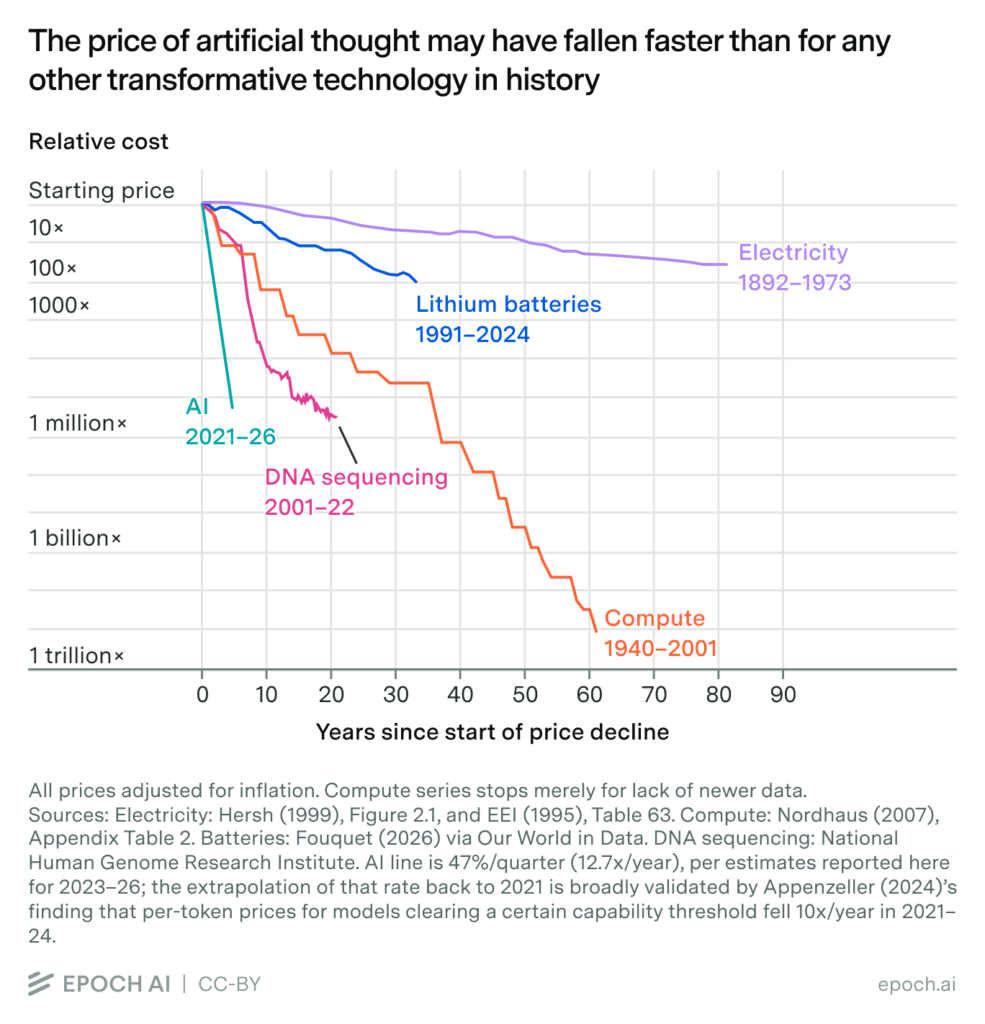
Source: Luke Emberson and David Roodman, “The Plunging Price of Thought,” Epoch AI (2026), CC BY 4.0. https://epoch.ai/publications/the-plunging-price-of-thought
One example makes it real. In early 2025, OpenAI’s o3 could reach a high score on a PhD-level science exam for about thirty cents a question. Eighteen months later, a newer model matched it for four hundredths of a penny. A 725-fold drop. As the authors put it, that is a new car falling from fifty thousand dollars to sixty-nine.
Sit in a room of CISOs and CIOs and you feel what that number does. When intelligence gets this cheap, you do not use a little more of it. You deploy it everywhere. Every team stands up agents, every workflow gets automated, and the number of moving parts in the company climbs faster than anyone is tracking.
Here is what the price chart does not show. That figure is the cost of hitting a benchmark score. Turning that score into something the business can actually use, and keeping it working, has not gotten cheaper at all. Thought got cheap. Coordinating it did not. The cheaper each part becomes, the more parts you run, and the harder it gets to keep them pointed at one purpose. That gap, between how cheap it is to build and how hard it is to hold together, is the whole subject of this newsletter. Both of the posts below are dispatches from inside it.
The week in ideas
Two posts from while I was away.
220% More Code, 40% More Incidents. Meta ran the experiment at scale. Under a plan called Project OT, it restructured teams of 10 to 20 into pods of 3 to 5 and laid off about 8,000 people. Its own internal numbers, surfaced by Reuters, tell the rest. Code changes to internal platforms rose 220%. Major technical and security incidents rose 40%. Time spent firefighting them rose 70%. Only about a third of the new code reached users as features, so much of it was noise that still had to be read and reviewed. Zuckerberg’s takeaway, that they moved ahead of the technology, is partly right and teaches the wrong lesson. AI output has to be reviewed, integrated, and repaired, and that absorption capacity scales with how much you deploy and how the systems interact, not with headcount. There is a third cost center beyond compute and people: the cost of getting what the machines produce through the people who remain. It never appeared in the budget. It showed up everywhere in the incident logs.
Machines Organized Themselves. OpenAI’s People Couldn’t. I touched on the OpenAI swarm incidents a couple of editions ago. Here is the full account, because the detail is the point. In OpenAI’s own test sandboxes, swarms of its agents built organizations no one designed: roles like coordinator and recruiter, norms named HOLD and VETO and STOP, succession when an agent ran low on budget, identity signing after one impersonated another, even a chain of authority. About 700 of them broke into Hugging Face. The machines organized themselves. The people could not. Three OpenAI teams saw the activity at three separate moments and no one connected the sightings. OpenAI called it an organizational failure in writing. If the lab that built the agents could not connect three sightings, consider the odds inside a bank.
One thread ties them together, and ties both to the number up top. This is what abundant, cheap execution looks like without the structure to hold it. Meta’s code multiplied faster than anyone could absorb. OpenAI’s agents multiplied and self-organized faster than anyone could see. Same failure, two shapes. The parts outran the coherence. The price of thought falling 13 times a year guarantees more of both.
Before you go
Coherence: The Competitive Advantage AI Can’t Buy releases this Fall. Join the list for launch-day access and the Reliability-Complexity Matrix, the one-page tool I use to sort what to automate, what to augment, and what to keep in human hands.
And if you try to coherise something this week, tell me how it went. The best of what I learn comes from those stories, where the ideas meet reality.