Newsletter – Edition 11
The date is set. Coherence: The Competitive Advantage AI Can’t Buy launches November 17 on Amazon. The manuscript is written, the interior is typeset, and the book is in its final proofreading pass. It is almost an object you can hold.
Before the launch details at the end, the idea itself.
What coherence is
Shireesh Thota, a corporate VP at Microsoft, read the book early and named what makes it different. His own career taught him that “locally correct decisions compound into complexity no one can untangle later.” The book’s insight, he wrote, is that “agentic AI does this to entire organizations at a speed software never reached,” and that Shashanka “has taken a hard-won lesson from systems engineering and shown it is now an organizational law.” He calls it “the rare AI book grounded in how complex systems actually fail.”
That is the novel part. Most people in enterprise AI now agree that making AI work within an organization is the hard part. The book goes further and treats a company as a system that fails in specific, nameable ways, the way any complex system does. Here they are, on one page.
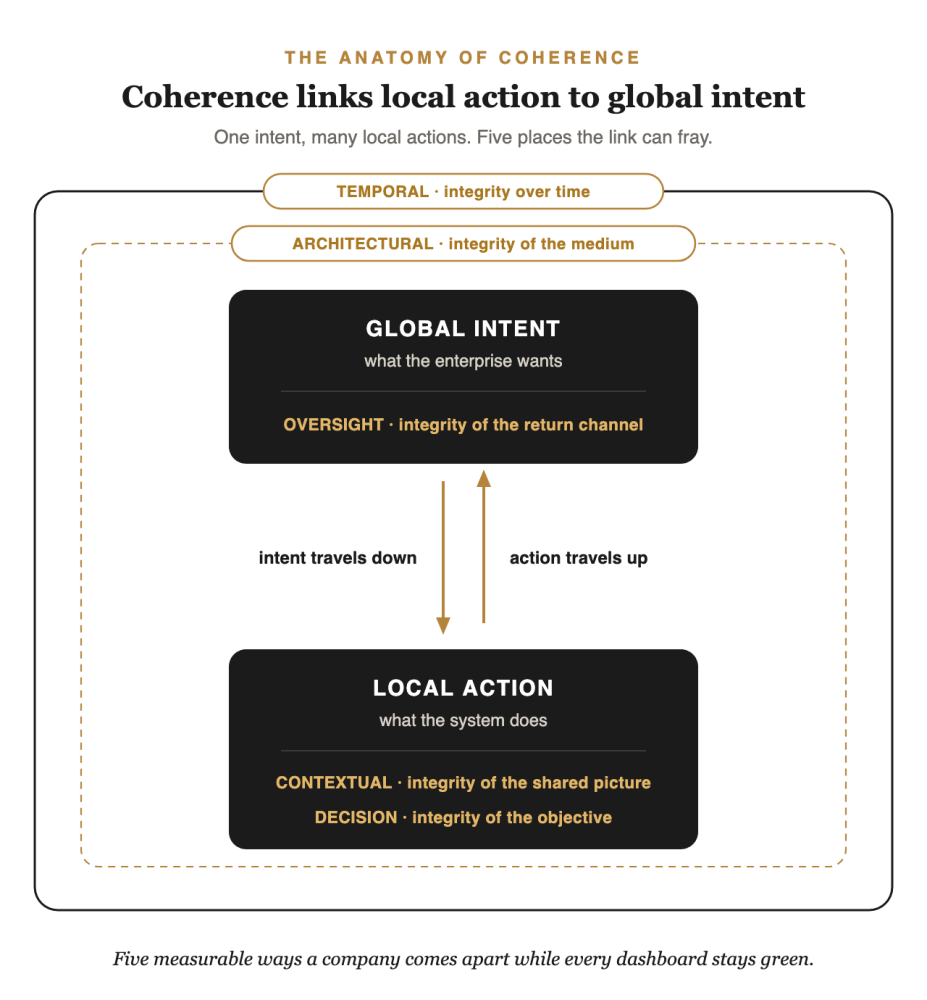
Coherence is the link between what a system does locally and what the enterprise actually intends. Intent travels down, visibility travels up, and the link can fray in five specific places: context, architecture, decision, oversight, and time. Each is a measurable way a company comes apart while every dashboard stays green, and the book turns each one into something a leader can see and manage.
Run one test on your own organization. If you cannot produce a current inventory of every autonomous system running inside it, you are at low coherence, whatever your dashboards say, because you cannot see your own coordination state. Most large enterprises fail that test today. The full walk-through of the five dimensions lives here.
The week in ideas
Two pieces from the past week.
Organizational Coherence Decides Whether AI Pays Off at Scale. My latest for the Forbes Technology Council. Most people are now productive with AI individually, yet far fewer enterprises can show it in the P&L, and the gap is coherence. The piece walks through a supply chain where three agents each optimize locally and together misread a temporary spike as the new normal, and what it takes to close that gap before you scale. Weigh in on LinkedIn…
Where the Bitter Lesson Stops. Richard Sutton’s bitter lesson says scaling and learning beat human cleverness, over and over. I think it holds right up to the enterprise and then stops. Agents self-organize brilliantly when pointed at one clear goal. A company is the opposite, many goals in tension with no single target to hand the machine, and supplying that direction is coordination work no amount of scale can learn away.
Here is the first half of that lesson from my own week. I gave the tools one clear goal, turn the book’s idea into a song and a short film. Suno composed the track, and Fable visualized the story and synced the images to the audio, and the result genuinely holds together. Point agents at a single, well-defined goal and they are remarkable. The trouble starts only when there is no single goal to hand them, which is the enterprise problem in one sentence. Watch the music video.
Before you go
When the book goes live on November 17, I will send you the link that morning. Two things would help it travel. Mark the date on your calendar, and forward that email to one person wrestling with AI at scale. One peer each is how this reaches the rooms I will never get into on my own.
And if you coherise something this week, tell me how it went. The best of what I learn comes from those stories.